The aspiration to break through the middle-income trap and narrow the development gap has always been a legitimate goal for any nation, and Vietnam’s target of double-digit GDP growth is currently at the center of To Lam’s policy direction.
Looking back at the development history of many Asian economies—such as South Korea, Taiwan, Singapore, and China—periods of growth exceeding 10% for several consecutive years have always served as a crucial foundation for accumulating resources, investing in infrastructure, and industrialization.
However, recent lessons from the global economy also demonstrate a key principle: rapid GDP growth does not necessarily equate to sustainable development.
Accordingly, quite a few countries—such as Thailand and Malaysia—once achieved very high GDP figures but ultimately fell into crisis due to inefficient investment, low labor productivity, and excessive reliance on external factors.
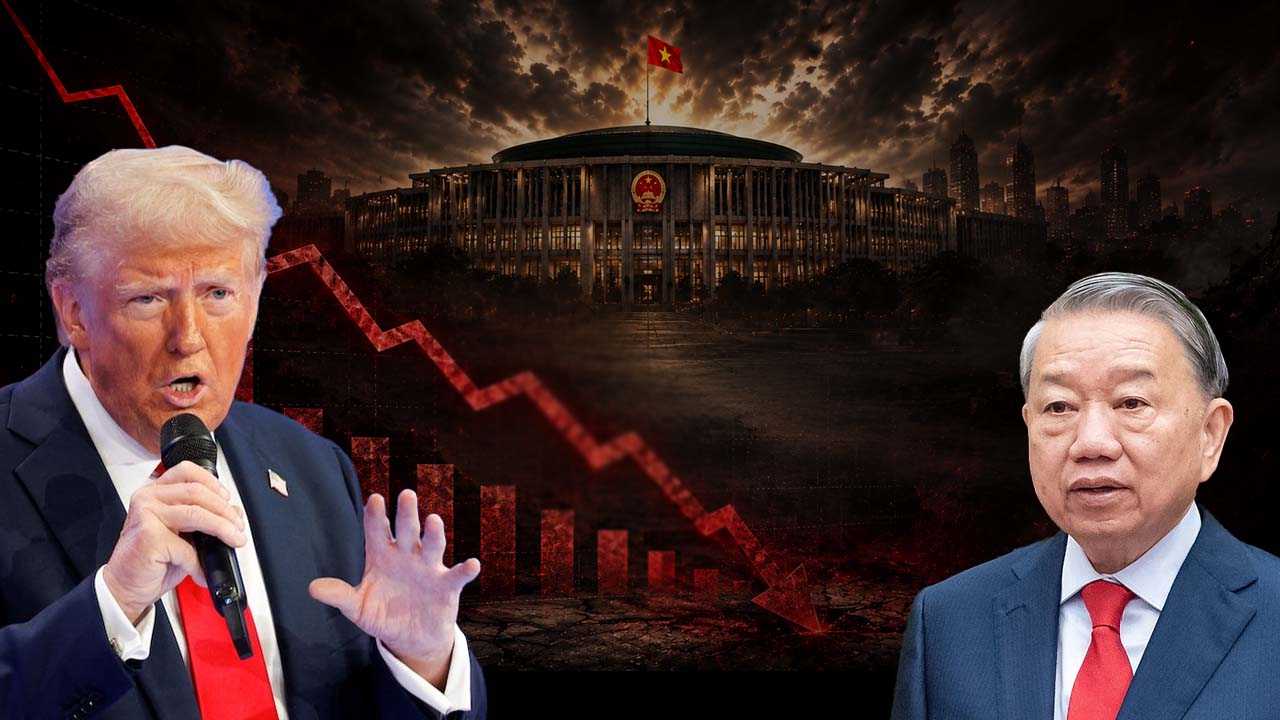
Therefore, the United States’ latest decision to impose a 12.5% trade tariff on goods from Vietnam, coupled with warnings regarding forced labor and intellectual property rights, serves as a serious wake-up call regarding the sustainability of the current growth model.
This development reflects the reality that the international trade environment is changing at a breakneck pace, where non-tariff barriers related to institutional frameworks, transparency, and labor standards are sometimes even harder to overcome than traditional tariff barriers.
This poses a major challenge to the growth ambitions of the leader of the Communist Party of Vietnam, given a macroeconomic governance mindset that is accustomed to chasing numbers with purely political significance.
For many years, the Vietnamese government under the leadership of General Secretary and President To Lam has consistently prioritized GDP growth as the primary measure of success, while neglecting other critical economic indicators as well as investment efficiency.
Consequently, the Vietnamese economy faces the risk of creating unsustainable prosperity, as profits from massive foreign direct investment (FDI) flows are repatriated to their home countries without corresponding increases in actual labor productivity.
When the leader’s “haste makes waste” mindset dictates political decisions aimed at forcing growth targets to the highest possible levels, the price paid is increased public debt pressure, resource waste, and growing inequality among economic sectors.
Furthermore, pressure from major trading partners such as the United States and China is forcing Vietnam to reevaluate the core values of development. In this context, the quality of institutions and the interests of the people must take precedence over mere statistical figures.
China’s strategic shift—from pursuing GDP at all costs to a high-quality development model based on innovation and domestic consumption—serves as a model demonstrating that all growth ambitions must adhere to objective economic laws.
For Vietnam under Mr. To Lam’s leadership, the current efforts to streamline the bureaucracy and reform the administrative system cannot be limited to superficial political campaigns or personnel reshuffles designed to serve the interests of those in power.
Rather, these efforts must truly become tools to unlock resources and build a transparent investment environment that complies with international standards.
People do not live on the percentage growth figures in performance reports; they live on stable jobs, real income, a quality healthcare and education system, and a safe, equitable living environment.
Therefore, the challenge facing Mr. To Lam is not to force the economy to grow faster at any cost, but rather to ensure it moves in the right direction, transforming all economic achievements into a better quality of life for the people.
Tra My – Thoibao.de